
Gravel calculator
Enter the area and depth to get cubic yards and tons of gravel. Choose a stone type to set a typical weight, or type your supplier's figure. The defaults are a 60 × 10 ft driveway topped up 4 inches deep.
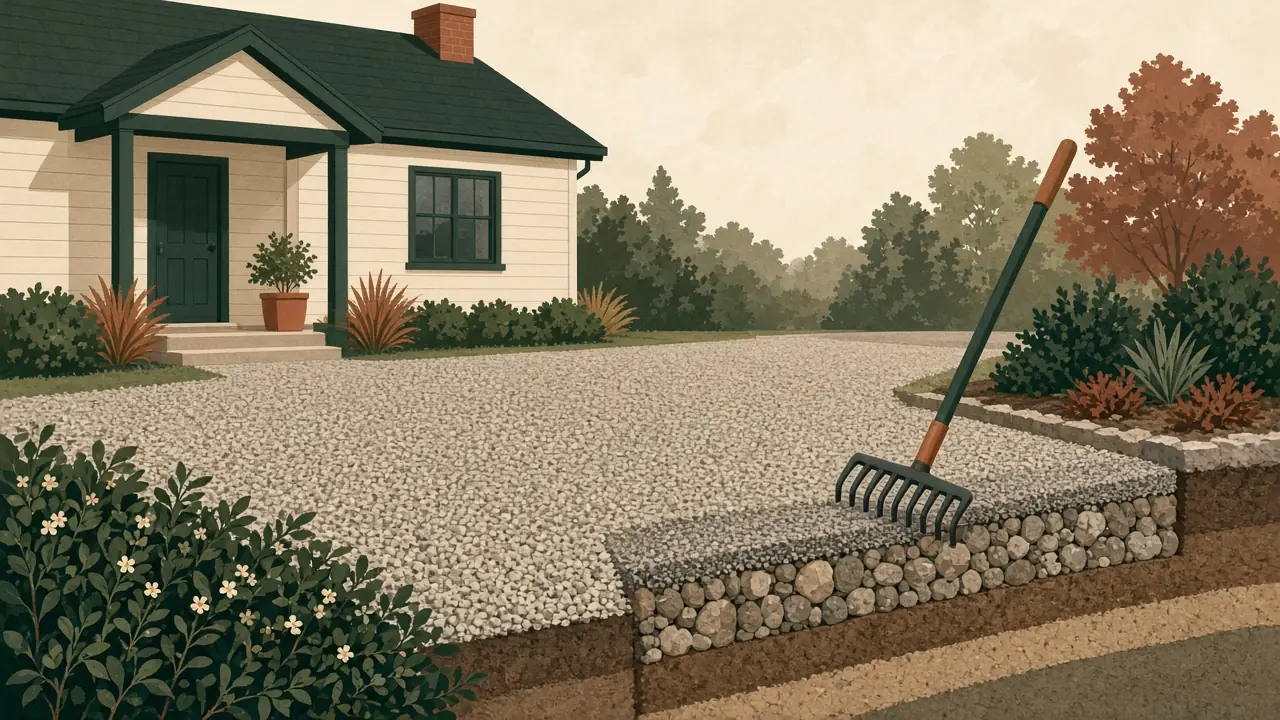
How the calculator works
- Area of the shape, in square feet.
- Volume: area × depth in inches ÷ 12 gives cubic feet. Divide by 27 for cubic yards. As a shortcut, square feet × inches ÷ 324 = cubic yards.
- Weight: cubic yards × the stone's weight per cubic yard gives tons. Quarries and landscape yards sell stone by the ton and soil or mulch by the yard, so you usually need both numbers.
Typical weights per cubic yard
These are one supplier's published planning figures for dry, loose material. Stone type, size mix and moisture all change them. Wet stone is heavier.
| Material | Tons per yd³ | Tonnes per m³ |
|---|---|---|
| Driveway / pea gravel / #57 crushed stone | 1.40 | 1.66 |
| Crusher run / road base / paver base | 1.50 | 1.78 |
| River rock (1–3 in) | 1.35 | 1.60 |
Worked example: topping up a driveway
A 60 × 10 ft driveway, 4 in of #57 stone:
- Area: 60 × 10 = 600 ft²
- Volume: 600 × 4 ÷ 12 = 200 ft³, which is 200 ÷ 27 = 7.41 yd³
- Plus 5%: 7.78 yd³
- Weight: 7.78 × 1.40 = 10.9 tons
The test suite checks this math against two worked examples published by American Rock Supply. The first is a 22 × 9 ft dip filled 3 in deep with road base: 1.83 yd³, 2.75 tons. The second is a 40 × 2.5 ft ditch lined with 6 in of #57: 1.85 yd³, 2.59 tons, or 2.72 tons with 5% extra.
Assumptions and things that change the answer
- Loose vs compacted. Dense-graded base (crusher run, road base) packs down when you run a plate compactor over it, so a compacted 4 in layer takes more than 4 in of loose stone. Ask your supplier whether their figure is for loose or compacted material, and adjust the allowance.
- Depth varies. Measure the depth in several places and use the average. At a 4 in target, if half the area is an inch deeper, the total goes up by about 12%.
- Weight varies by quarry. Published ranges for crushed stone run from about 1.35 to 1.7 tons per cubic yard. Use “My supplier's figure” when you have one.
Call 811 a few days before you dig to have buried utilities marked. It's a free service in the US. A loaded dump truck is very heavy. Keep it off septic tanks and drain fields, and off thin concrete or new pavers. Ask the driver where they can safely tip.
Questions worth answering
How much area does a ton of gravel cover?
At 1.40 tons per cubic yard, one ton is about 0.71 yd³ (19.3 ft³). That covers roughly 116 ft² at 2 in deep, 77 ft² at 3 in, or 58 ft² at 4 in. Heavier stone covers less.
How deep should driveway gravel be?
A new driveway is built in layers, usually a coarse base, then a middle layer, then a top dressing, and it's deeper than a top-up. See the gravel driveway guide and run this calculator once per layer.
Sources
- American Rock Supply, Gravel calculator, step by step (weights per cubic yard and worked examples).
- New York Rock Supply, Yards, tons and calculators (the same published weights; “sold by the ton” vs “by the yard”).
- Yard Work Math, Gravel yards to tons (supplier ranges of 1.35–1.7 tons/yd³ for crushed stone).
- Common Ground Alliance, Call 811.