
Concrete calculator
Enter the size of your slab, footing or post holes to get cubic yards and the number of 40, 60 or 80 lb bags to buy. The defaults below are a 10 × 10 ft patio, 4 inches thick.
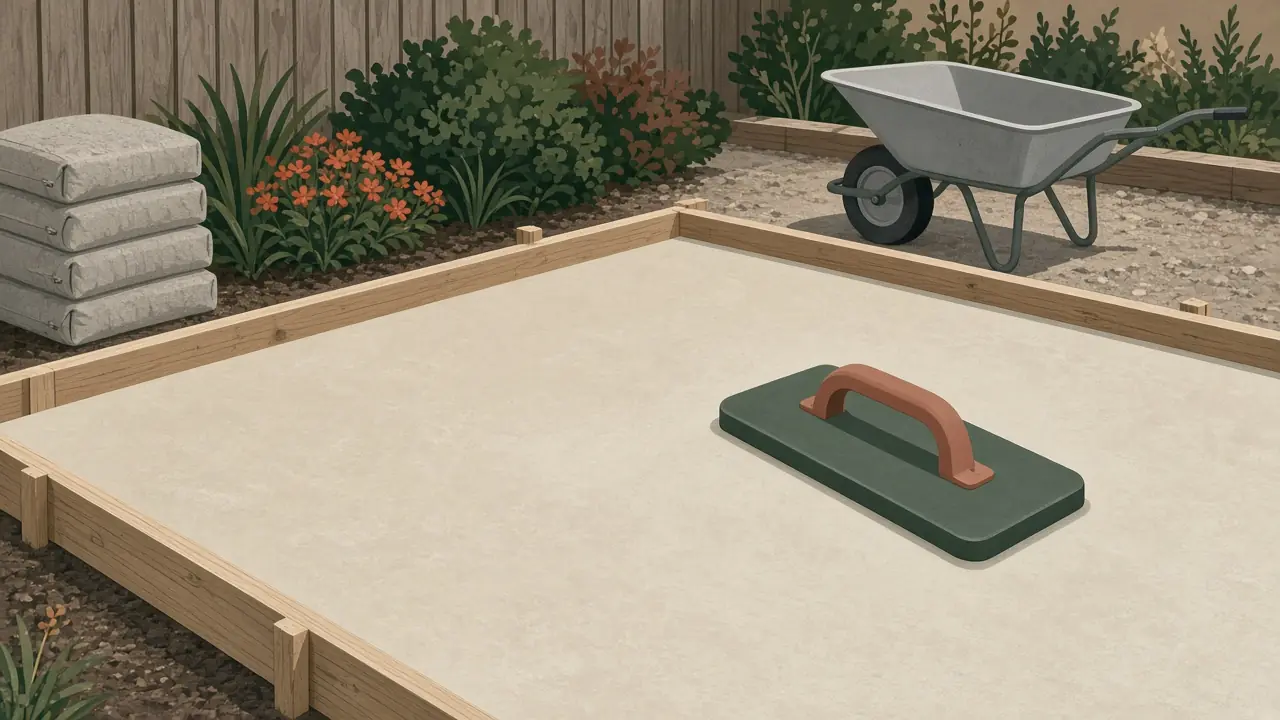
How the calculator works
Concrete is ordered by volume. Every option above does the same three steps:
- Volume. For a slab, it's area × thickness. A footing is length × width × depth. A round post hole or column is π × (diameter ÷ 2)² × depth, times the number of holes. Inches are divided by 12 to get feet.
- Cubic yards. Cubic feet ÷ 27, because a cubic yard is 3 × 3 × 3 ft. Ready-mix trucks sell by the cubic yard.
- Bags. The volume, plus your waste allowance, divided by what one bag makes, then rounded up to a whole bag. QUIKRETE and Sakrete both publish the same yields: 0.30 ft³ for a 40 lb bag, 0.45 ft³ for a 60 lb bag and 0.60 ft³ for an 80 lb bag.
Worked example: a 10 × 10 ft patio
A 10 × 10 ft patio at 4 in thick:
- Area: 10 × 10 = 100 ft²
- Volume: 100 × 4 ÷ 12 = 33.3 ft³, which is 33.3 ÷ 27 = 1.23 yd³
- With 5% waste: 35.0 ft³ (1.30 yd³)
- 80 lb bags: 35.0 ÷ 0.60 = 58.3, so buy 59 bags (or 78 × 60 lb, or 117 × 40 lb)
That's roughly 4,700 lb of dry mix to carry and mix by hand. One full cubic yard takes 45 × 80 lb bags (27 ÷ 0.60). Somewhere around that size, a rented mixer or a ready-mix delivery stops being a luxury. Ask local suppliers about their minimum order and any short-load fee before you decide.
Assumptions and things that change the answer
- Bag yields are approximate. Both manufacturers say yields don't allow for an uneven subgrade or waste. That's what the waste field is for. Raise it if the ground under your forms is lumpy.
- Measure the real thickness. A 2×4 is actually 1½ × 3½ in. QUIKRETE's own patio instructions dig for 3½ in of concrete when using 2×4 forms. If you want a true 4 in slab, the forms and excavation have to allow for it.
- Other mixes yield differently. Fast-setting, crack-resistant and high-early-strength mixes may differ. Check the yield printed on the bag and divide by that instead.
- Footing and slab sizes are not design advice. Footings for structures, and slabs that will carry vehicles, follow your local building code and sometimes an engineer's drawing. The calculator only counts the material.
Portland cement is strongly alkaline. OSHA warns that wet concrete can cause serious chemical burns, and you may not feel the damage right away. Wear waterproof gloves, long sleeves and eye protection. Don't kneel in wet concrete. Wash skin promptly with clean water. An 80 lb bag is a heavy lift; bend your knees or use the smaller bags.
Questions worth answering
How many bags of concrete are in a cubic yard?
At the published yields: 45 × 80 lb bags, 60 × 60 lb bags or 90 × 40 lb bags (27 ft³ ÷ 0.60, 0.45 or 0.30).
How many bags for a fence post?
Choose “Post holes” and enter your hole diameter and depth. For example, four 12 in holes, 36 in deep, are 9.4 ft³: 16 × 80 lb bags before waste, 17 with the default 5%. QUIKRETE's rule of thumb is a hole half as deep as the post stands above ground, so a 9 ft post goes 3 ft down for a 6 ft fence. Check your local frost depth for gate and deck posts.
Sources
- QUIKRETE, Concrete Mix specification sheet (yields per bag) and Concrete calculator (“yields are approximate and do not allow for uneven substrate, waste, etc.”; post depth guidance).
- Sakrete, High-Strength Concrete Mix technical data sheet (yields; L × W × thickness ÷ 12 coverage method).
- QUIKRETE, Building a concrete patio (3½ in of concrete with 2×4 forms).
- OSHA, Preventing skin problems from working with Portland cement.